

Say Goodbye to the Drill: How Laser Dentistry Delivers Painless Gum Treatment & Faster Healing
If the sound of a dental drill sends a chill down your spine, you aren’t alone. Dental anxiety keeps millions of people from seeking the care they need, especially when it comes to soft tissue issues like gum disease, gummy smiles, or oral lesions. Traditional gum surgery used to mean scalpels, invasive cutting, drills, and weeks of uncomfortable recovery with stitches.
Fortunately, modern dental technology has completely transformed this experience.
Enter the age of soft tissue laser dentistry. Today, gentle light energy replaces harsh mechanical tools, making painless dental laser procedures a reality. If you’ve been putting off necessary care due to fear, here is how laser gum treatment offers a gentler, faster, and stress-free alternative.
What is Soft Tissue Laser Dentistry?
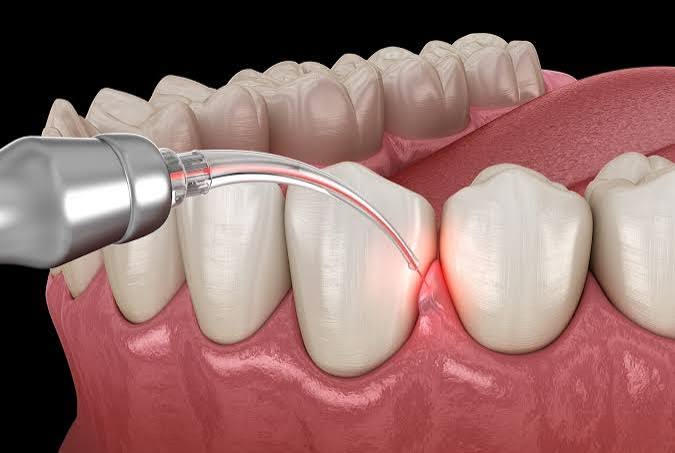
- Soft tissue laser dentistry utilizes concentrated light beams tuned specifically to target and treat the soft tissues of your mouth namely your gums. Unlike hard tissue lasers used on tooth enamel, soft tissue lasers absorb water and hemoglobin, allowing them to vaporize diseased tissue while instantly sealing blood vessels and nerve endings.
- Instead of scraping away at inflamed tissue or making surgical incisions, your dentist simply glides a small, fiber-optic wand over the target area. The high-energy light sterilizes the region on contact, eliminating harmful bacteria without disturbing healthy surrounding tissues.
Why Laser Gum Treatment Beats Traditional Methods
Switching from traditional periodontal surgery to advanced laser dentistry treatment brings a list of life-changing benefits:
1. Truly Painless Gum Treatment
- Because the laser seals nerve endings as it works, most patients feel little to no pain during or after the procedure. In many cases, dentists can perform painless dental laser treatments without local anesthesia or injections.
2. No Drills, Scalpels, or Stitches
The absence of noisy drills instantly lowers stress for anxious patients. Furthermore, because the light beam precision-targets infected areas without cutting into healthy tissue, there’s no need for uncomfortable sutures (stitches) afterward.
3. Minimal Bleeding and Swelling
- As the laser removes damaged tissue, it simultaneously cauterizes blood vessels. This results in almost zero bleeding during the procedure and significantly reduces post-treatment swelling.
4. Faster Healing and Tissue Regeneration
- One of the most impressive aspects of laser gum treatment is its ability to stimulate your body’s natural healing response. The light energy encourages cellular regeneration, allowing your gums to heal faster and reattach securely to your teeth often in a fraction of the time traditional surgery requires.
5. Sterilization & Reduced Risk of Infection
- Dental lasers kill 99% of periodontitis-causing bacteria in gum pockets on contact. This built-in sterilization dramatically lowers the risk of post-procedure infection and relapse.
Operculectomy the surgical removal of the operculum (the flap of gum tissue partially covering a tooth, most commonly an erupting third molar/wisdom tooth)—has traditionally been performed with a scalpel or electrosurgery.
However, dental lasers (such as Diode, Er:YAG, Nd:YAG, and CO_2 lasers) have rapidly become the preferred modern approach for this procedure.
Key Clinical Uses & Advantages:
1. Superior Hemostasis
Thermal Coagulation: As the laser cuts, it simultaneously seals small blood vessels and capillaries.
Clear Surgical Field: Gives the dentist excellent visibility throughout the procedure without continuous suctioning or excessive sponge clearing.
2. Precise Soft-Tissue Vaporization
Targeted Tissue Ablation: Lasers allow high micro-precision, removing only the exact amount of thick or inflamed fibrous tissue without damaging adjacent healthy gums or the underlying tooth surface.
Minimal Collateral Damage: Unlike scalpel incisions, lasers cause very little thermal or mechanical injury to neighboring tissue.
3. Immediate Sterilization & Decontamination
Bacterial Reduction: Operculitis is often driven by trapped bacteria under the tissue flap (pericoronitis). The thermal action of the laser kills bacteria in real-time, significantly lowering the risk of post-operative infection.
4. Reduced Need for Sutures & Local Anesthesia
No Sutures Required: Because the laser seals the tissue margins instantly, stitches are rarely needed.
Less Anesthesia: Topical numbing agents or minimal local infiltration are often sufficient, making the experience more comfortable for patients apprehensive about needles.
5. Enhanced Healing & Less Post-Op Pain
Biostimulation (Photobiomodulation): Laser energy stimulates cellular repair, reducing post-operative inflammation and swelling.
Nerve Sealing: Lasers seal free nerve endings in the soft tissue, leading to a noticeable reduction in post-procedure pain compared to traditional scalpel surgery.
Common Clinical Indications:
Management of Pericoronitis: Eliminates severe, recurring inflammation around partially erupted wisdom teeth.
Eruption Facilitation: Helps pediatric or orthodontic patients whose teeth are unable to break through tough, fibrous gum tissue.
Pre-Prosthetic Preparation: Removes excess tissue flap so a tooth can be properly prepared for a crown or bridge.
Lasers in Root canal treatment:
- In modern endodontics (root canal treatment), lasers—primarily Diode, Nd:YAG, Er:YAG, and Er,Cr:YSGG lasers—are increasingly used as adjuncts to traditional mechanical cleaning and shaping techniques.
While hand/rotary files remove the main bulk of infected tissue inside the canal, lasers are used to clean, disinfect, and prepare areas that traditional metal instruments simply cannot reach.
Key Uses of Lasers in Root Canal Treatment
1. Advanced Canal Disinfection & Bacterial Elimination
- Deep Dentinal Penetration: Traditional liquid irrigants (like sodium hypochlorite) penetrate dentinal tubules up to roughly 100\ \mu\text{m}. Lasers can penetrate up to 1,000\ \mu\text{m} (1 mm) into the dentin, neutralizing deeply embedded bacteria (such as Enterococcus faecalis).
Photothermal Destruction: Laser light vaporizes bacterial cell walls and neutralizes stubborn endodontic biofilms without relying solely on chemical agents.
2. Removal of Smear Layer & Debris
- During mechanical filing, a layer of micro-debris and bacteria (the smear layer) is packed against the canal walls.
- Erbium lasers (Er:YAG and Er,Cr:YSGG) effectively melt or ablate this smear layer, opening up the dentinal tubules so antibacterial rinses and final sealing materials can penetrate more deeply.
3. Laser-Activated Irrigation (LAI / PIPS / SWEEPS)
- Specialized techniques like PIPS (Photon-Induced Photoacoustic Streaming)or SWEEPS (Shock Wave Enhanced Emission Photoacoustic Streaming) use low-energy Erbium laser pulses inside liquid irrigants.
- The laser creates acoustic shockwaves that forcefully drive fluid throughout complex root canal anatomies—including curved canals, lateral canals, and deltas—that physical files cannot touch.
4. Pulp Debridement & Vaporization
- Lasers can quickly vaporize infected or necrotic pulp tissue in the main canal space, reducing the physical strain on mechanical files and speeding up initial canal preparation.
5. Apicoectomy & Endodontic Surgery
- Root Tip Resection: Erbium lasers can cleanly cut through bone and the root apex during surgical root canal procedures (apicoectomies).
- Retro-Cavity Preparation:Used to prepare the root end for a retrograde filling while minimizing micro-fractures in surrounding dentin.
Common Applications for Soft Tissue Lasers
- Soft tissue lasers aren’t just for treating gum disease—they are versatile tools used across a wide range of preventive and cosmetic procedures:
- Periodontal Pocket Disinfection: Clearing deep bacterial pockets around teeth to stop gum disease in its tracks.
- Gummy Smile Corrections (Gingivectomy): Reshaping uneven or excess gum lines to expose more of your natural smile.
Frenectomy: Treating tongue-ties or lip-ties easily and painlessly.
Cold Sore & Canker Sore Relief: Instantly dulling pain and speeding up the healing time of painful mouth ulcers.
Frequently Asked Questions
What to Expect During and After Treatment?
Phase What Happens
- Preparation Minimal to no local anesthetic is applied. You’ll wear protective eyewear while the light wand is prepared.
- The Procedure Your dentist guides the laser fiber over the gums. You may feel mild warmth or light pressure, but no sharp pain or vibrations.
- Immediate Post-Care You can walk out of the clinic and immediately return to your normal daily routine.
- Recovery Expect mild tenderness for 24–48 hours at most—far superior to the week-long recovery associated with traditional gum surgery.
Is Painless Laser Dentistry Right for You?
If you have bleeding gums, persistent bad breath, receding gum lines, or dental anxiety, laser dentistry treatment could be the perfect solution. Modern soft tissue laser dentistry allows you to protect your oral health without sacrificing comfort or wasting days in recovery.
Take the next step: Talk to your dentist today to see if a painless dental laser procedure is an option for your oral care needs, and take the stress out of your next dental visit!